/avatar.jpeg

Jan-Otto Kröpke

Principal Cloud Architect

Welcome to my personal blog! Here I share my thoughts, experiences, and insights on various topics related to technology, programming, and life.

Kubernetes Image Volumes for Platform-Managed Runtimes - Part 1

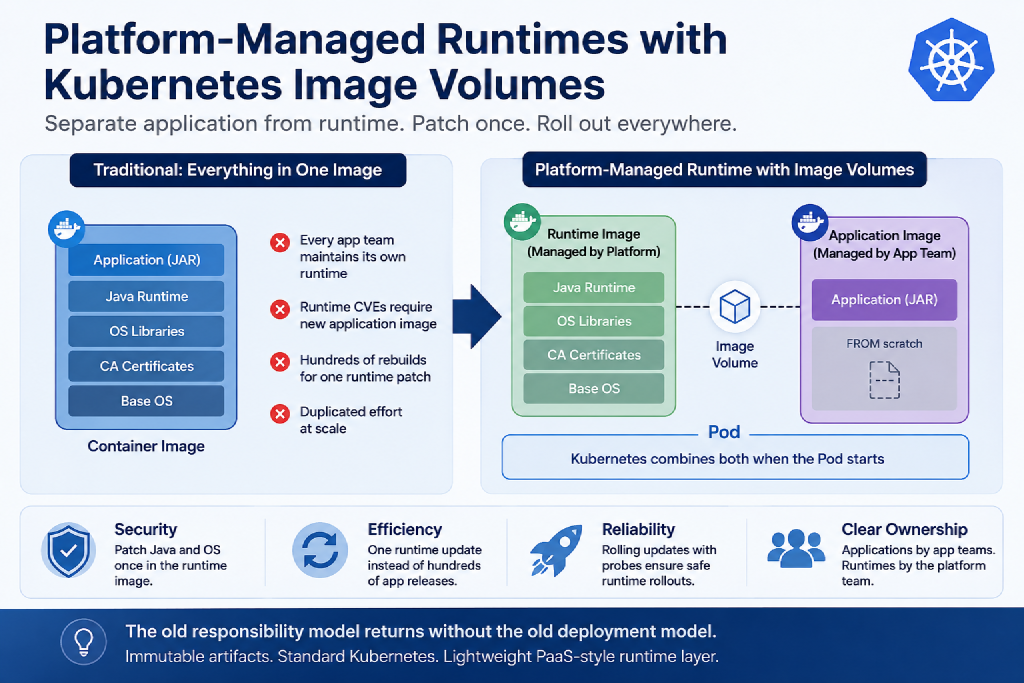
Since Kubernetes v1.36, image volumes are stable. They allow Kubernetes to pull an OCI image or artifact and mount its filesystem into a container. At first glance, this looks like a small storage feature, but it enables a much more interesting concept: platform-managed runtimes.

In this model, the application team publishes the application artifact, while the platform team provides and maintains the environment required to run it. Kubernetes combines both when the Pod starts, so the application team no longer needs to package Java, operating system libraries, and CA certificates into every application image.

Handling Large Files and CRDs in Helm and the 1MB Release Limit

Helm is a fantastic packaging and lifecycle tool—until you hit one of its hardest limits:

Error: create: failed to create: Secret "sh.helm.release.v1.my-release.v1" is invalid: 
data: Too long: must have at most 1048576 bytes

Helm stores release state in a Kubernetes object, and Kubernetes objects have a hard 1 MiB size limit. If your chart grows large (hello, “monster CRDs”), you can end up in a situation where helm install/upgrade fails even though nothing is “wrong” with your Kubernetes cluster.

The False Security of Pinned GitHub Actions Commit Hashes

Many developers use GitHub Actions. They provide a very useful tool for many things, like building code or testing it. Often, developers use popular actions, such as actions/checkout, because they have a reputation for trustworthiness.

But could someone change a trusted action without anyone knowing?

In this post, a problem with how GitHub forks work will be shown. This problem lets a bad person put their own code into a trusted action, even if they lack permission to change the action.

DNS Hijacking in Kubernetes

Kubernetes DNS provides a streamlined way for pods to discover one another using short, user-friendly names, keeping complex IP addresses out of sight. Yet, this very convenience can mask a significant security flaw. Without a thorough grasp of Kubernetes DNS behavior, an opening for attackers might unknowingly be created. Consider this: the ability to create namespaces and services allows an attacker to reroute traffic intended to leave a cluster, diverting it for their own purposes.